Projects:
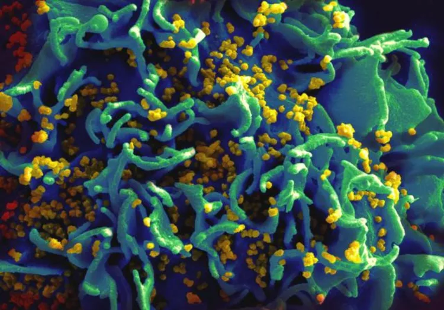
National Institute of Allergies and Infectious Diseases (NIAID) from https://www.verywellhealth.com/hiv-microscopy-in-pictures-48651
Project Description: Coupling the dynamics of a human immune system in the presence of an HIV virion with a population level epidemiological model of disease spread presents several challenges. In this project, we are developing a combined model where the infectiousness of the individual is a function of the viral load of the individual.
Faculty: Hoffman, Katharine Gurski (Howard U)
Student(s): Maliha Noushin
References:
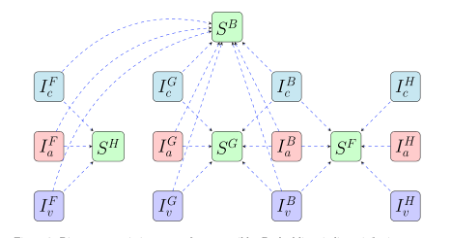
Project Description: HIV treatments come with many side effects, which leads to compliance issues. If instead of taking a constant dose of medication, there was an on-again, off-again strategy for dosing of medication that depended on the viral load of the individual. This would reduce the toxicity of the treatment for the individual. Using methods of parameter estimation, sensitivity, and identifiability, we develop a model of STI for HIV treatment.
Faculty: Hoffman, A. Biswas, K. Gurski, and.
Student(s): Matt Lastner
References:
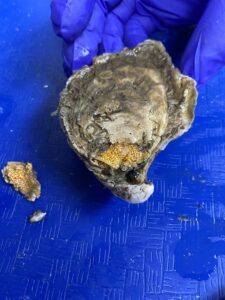
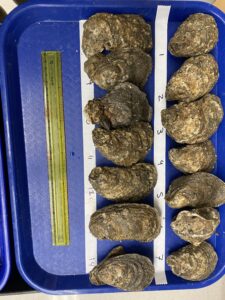
Project Description: Oyster aquaculture in a growing industry in Chesapeake Bay and globally that supports both healthy waterways and the economy. While growing oysters in the wild has many benefits, such as a free food supply, diseases and other stressors threaten oyster aquaculture. We are conducting a novel survey of four oyster parasites across oyster farms in Maryland and Delaware to examine how patterns of disease relate to multiple environmental factors. This project also compares the impacts of parasites across four different seasons to explore how shifts in temperature and salinity impact parasite coinfection and host body condition. Sampling from farms offers a unique opportunity to engage with oyster farmers to learn about recent challenges with growth and survival and integrate their feedback into the sampling design. Results thus far indicate the importance of farm-specific conditions and interactions between multiple parasites. This project is supported by Agriculture and Food Research Initiative Competitive Grant no. 2024-67015-42418 from the USDA National Institute of Food and Agriculture.
Faculty: Allison Tracy (Marine Biotechnology)
Student(s): Kristina Colacicco, Allyson Kido
Relevant References:
Tracy, A.M., Lohan, K.M.P., Carnegie, R.B., McCollough, C.B., Southworth, M. and Ogburn, M.B., 2024. Co-infection is linked to infection prevalence and intensity in oysters amidst high environmental and spatial variation. Journal of Invertebrate Pathology, 207, p.108201. https://doi.org/10.1016/j.jip.2024.108201
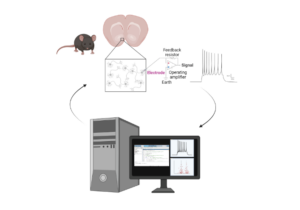
Project Description: Using data to inform models of nucleus accumbens neurons in mice Tara LeGatesin the Department of Biological Sciences and Kathleen Hoffman in the Department of Mathematics and Statistics has been investigating parameter identifiability and estimation for the Izhikevich model of neurons in the nucleus accumbens, a key area of the brain that mediates motivated behaviors and is implicated in stress-based psychiatric disorders like depression. We record firing properties from individual neurons in the mouse brain using whole-cell patch clamp data, which we use to inform our model and estimate parameters. Preliminary results have shown that the value of some of the parameters depend on the sex of the mouse as well as exposure to environmental stress. This work began as part of Ashley Copenhaver’s Ph.D. dissertation and has continued with the efforts of undergraduate research students Owen Tolbert and Branwen She, as well as Master’s student Matyas Marek.
Faculty: Hoffman, and Tara LeGates (Bio)
Student(s): Ashley Copenhaver and Matyas Marek
References:
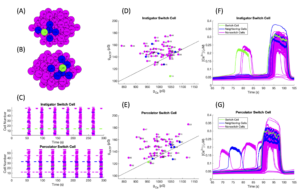
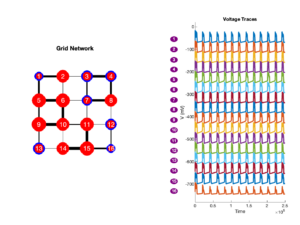
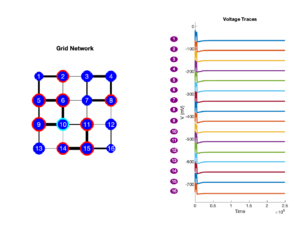
Project Description: Can an individual beta cell control the synchronization of an entire islet? What conditions may be necessary or sufficient for the network structure and nonlinear cellular dynamics to support such a cell, a switch cell? We consider reduced model cells and networks to address these questions.
Faculty: Peercy
Student(s): Zainab Almutawa
References:
- β Bradford E. Peercy and David J Hodson, Synchronizing beta cells in the pancreas ELife 13, e95103 (2024)
- β Bradford E. Peercy and Arthur S. Sherman, Do Oscillations in Pancreatic Islets Require Pacemaker Cells? Journal of Biosciences, Feb 25; 47:14 (2022)
- β Janita Patwardhan HoganG and Bradford E. Peercy, Flipping the Switch: Islet Desynchronization through Cell Silencing. PLoS ONE, Apr 2 (2021)
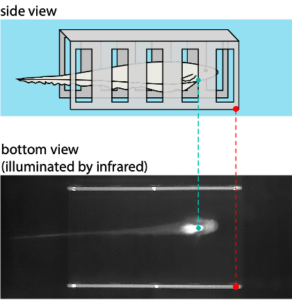
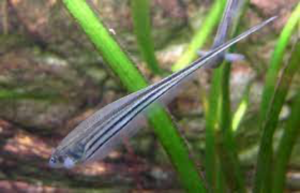
Project Description: We are investigating the mechanisms for active sensing using the electric fish as a model organism. The collaboration that includes biologists, mathematicians and engineers has identified a common velocity distribution across taxa, species, and sensing modalities. Continuing analyses of experimental data has shown that for a stationary shuttle that the fish has preferred positions within the shuttle related to shuttle windows.
Faculty: Hoffman, Noah Cowan (JHU), Andrew Lamperski (UMN), and Eric Fortune (NJIT)
Student(s):
References:
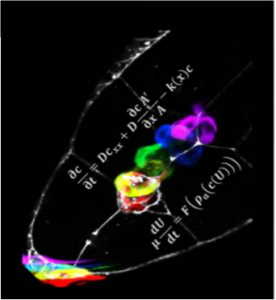
Project Description: In development cell migration is a critical component. We study the fruit fly egg chamber development. Mathematical models can help generate testable hypotheses for quantities that are challenging to capture experimentally. We combine genetic mutation with reaction diffusion equations and/or agent based models to capture chemoattractant distribution and clustered cell migration.
Faculty: Peercy (Math) and Starz-Gaiano (Bio)
Student(s): Lara Scott
References:
- A. George, N. Akhavan, BE Peercy, M. Starz-Gaiano,Alexander, Chemotaxis of Drosophila border cells is modulated by tissue geometry through dispersion of chemoattractants, iScience, Volume 28, Issue 3, 111959.
- ⊙ Bradford E. Peercy, Michelle Starz-Gaiano, Clustered cell migration: Modeling the model system of Drosophila border cells. Seminars in Cell & Developmental Biology, (2020). [Pubmed]
- News Story on Interdisciplinarity by Sarah Hansen

Project Description: Experiments performed in the Padmanahban laboratory show sustained tumor growth in mouse ovaries. We use an advection equation for probability density of matestatic tumor cell size to compare with Wild Type and mutant data.
Faculty: Peercy (Math) and Padmanahban (Bio)
Student(s): Jessica Hoffman
References:
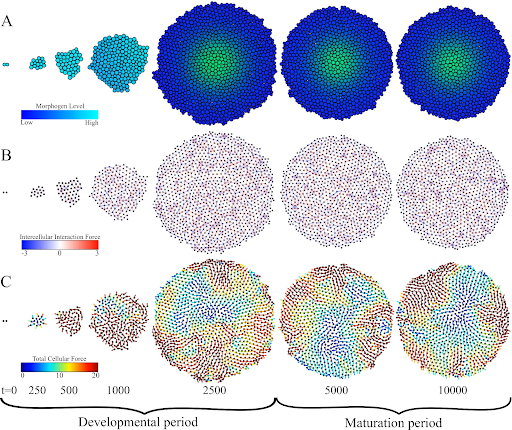
Project Description: The processes controlling the feedback between cellular behaviors and mechanochemical signals to achieve precise and stable tissue morphologies are poorly understood. This project will develop new agent-based methods based on high-performance computing to enable the simulation of whole-body organisms composed of millions of cells that grow, divide, and die based on diffusible morphogens. These methods will pave the way for elucidating the mechanisms of the regulatory dynamics of development and regeneration and pave the way for novel biomedical and bioengineering applications.
Faculty: Daniel Lobo
Student(s): Emma Chaney
References:
B. Kaity, D. Lobo. 2025. Emergent stable tissue shapes from the regulatory feedback between morphogens and cell growth. bioRxiv, doi: 10.1101/2025.02.16.638504.
J.M. Ko, W. Reginato, A. Wolff, D. Lobo. 2024. Mechanistic regulation of planarian shape during growth and degrowth. Development, 151 (9): dev202353.
R. Mousavi, D. Lobo. 2024. Automatic design of gene regulatory mechanisms for spatial pattern formation. NPJ Systems Biology and Applications, 10(35).