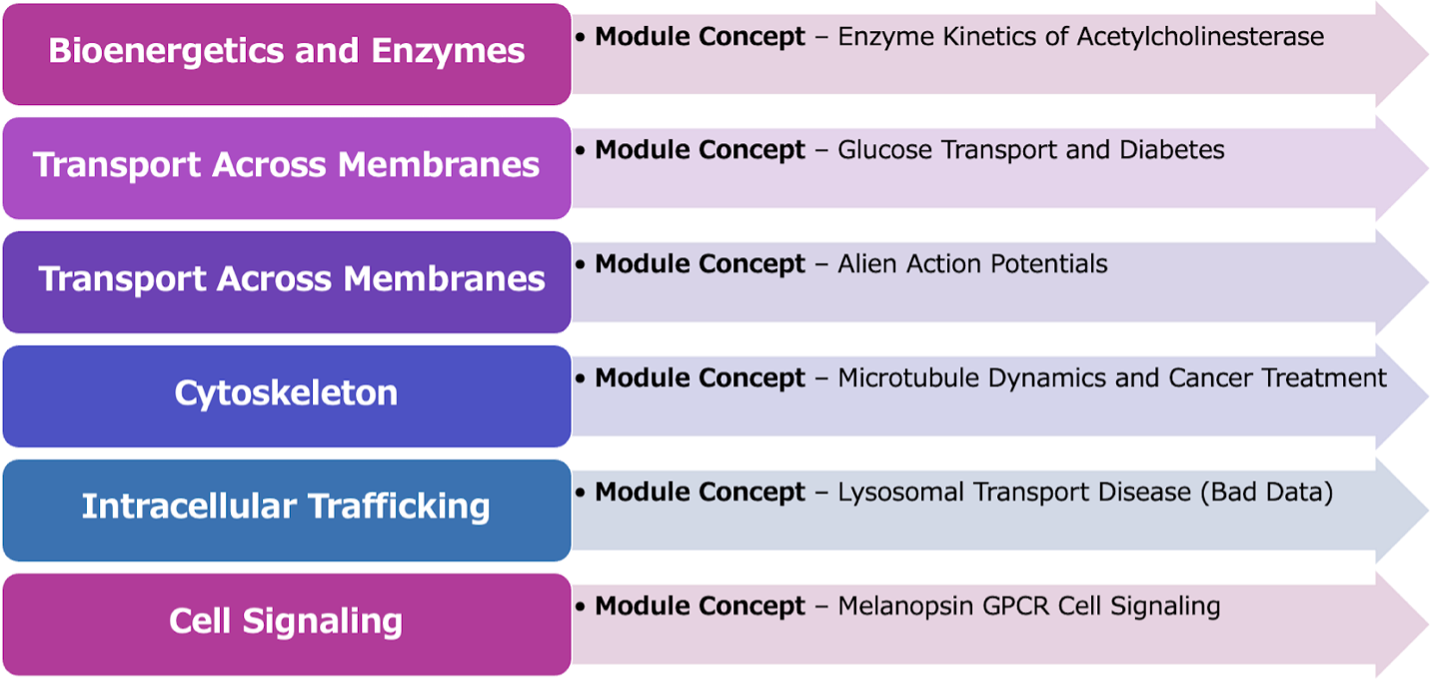
Training is a multi-pronged approach. We have developed courses that cover core and classical topics. We have developed mathematical modules for community college biology courses to engage the power and applicability of quantitative reasoning. And we work at a high level with individual and groups of students on cutting edge research projects.
CIMBRE Academic Courses:
MATH 355 (Biomathematics)
MATH 469 (Math Physiology)
MATH 710 (Topics: Research Methods)
BIOL 463 (Theoretical and Quantitative Biology)
BIOL 487 (Medical Case Studies)
Biomath/Quantitative Bio minors:
Bioinformatics and Computational Biology (BINF) Major
Double Major in Math (BS or BA) and Biological Sciences (BS or BA) and/or minor(s)
Education work
UMBC was one of four institutional partners in the National Experiment in Undergraduate Science Education (2011-2015) or NEXUS funded by the Howard Hughes Medical Institute (HHMI). The NEXUS institutions, which also include the University of Maryland, College Park, Purdue University, and the University of Miami, developed and piloted interdisciplinary modules to complement introductory undergraduate life science instruction and integrated quantitative thinking into the introductory biology topics. Results from modules piloted in an introductory biology course showed student improvement in quantitative skills across semesters.
In addition, a capstone medical case studies course developed by University of Miami, as part of this collaboration, has been institutionalized at UMBC through the course Biol 487, Medical Case Studies. The course takes teams of undergraduate students through five interdisciplinary medical case studies. At the end of the course, teams of students develop their own medical case study, some of which are used in subsequent semesters.
https://www.lifescied.org/doi/10.1187/cbe.15-09-0186
The NEXUS Institute for Quantitative Biology (NIQB), Improving Undergraduate STEM Education (IUSE) Project was funded from 2018-2024 by the National Science Foundation. This project was a collaboration between the University of Maryland, Baltimore County (UMBC) and our top sending community colleges: Anne Arundel Community College (AACC), Community College of Baltimore County (CCBC), Howard Community College (HCC), and Montgomery College (MC). This collaboration expanded on previous work conducted as part of the STEM Transfer Success Initiative (t-STEM), NEXUS at UMBC, and STEM BUILD at UMBC. The project began with a curriculum review to locate places to include more quantitative modules, and then faculty groups worked collaboratively across disciplines and institutions to develop/revise, implement, assess and disseminate competency-based, active learning quantitative biology modules. Preliminary data from the Cell Biology course showed significant total growth in quantitative goals for all modules and significant positive correlations between post-assessment performance and overall gain across the modules.